Chapter II: Homoeopathic Approach
Question - Answer Format of Chapter II "Homoeopathic Approach" from the book: Biostatistics and Research Methodology in Homoeopathy
Homoeopathy and Philosophy
Q: What is Homoeopathy (Homeopathy)?
A: Homoeopathy is a scientific method of treating patients based on its own philosophy (known as "Laws of Homoeopathy").
Q: How is Homoeopathy based on science and philosophy?
A: Homoeopathy is a medical system uniquely founded on both science and philosophy, blending measurable observations with deeper understanding of life principles:
🔬 Scientific Foundation:
- Homoeopathy uses a systematic method of clinical observation, symptom analysis, and individualized diagnosis.
- It relies on the Law of Similars (“like cures like”) and the use of dynamized medicines, which are prepared through specific scientific processes like potentization.
- The selection of remedies is based on a careful evaluation of the complete symptom picture—a logical and repeatable process.
- It aims to stimulate the body’s natural healing response, a concept that aligns with modern ideas of self-regulation and systemic balance.
- It acknowledges the presence of a vital force — an immaterial dynamic energy that maintains health and harmony in the living being.
- Based on principles like individualization, holism, and minimum dose, it emphasizes gentle, long-term healing rather than temporary relief.
- Its philosophical roots include elements of ethics, logic, metaphysics, and epistemology, which guide the practice toward moral, rational, and personalized care.
In essence, Homoeopathy is a bridge between scientific reasoning and philosophical depth, offering a system that treats disease by understanding the deeper nature of health and life.
🔬 Scientific Foundation:
- Homoeopathy uses a systematic method of clinical observation, symptom analysis, and individualized diagnosis.
- It relies on the Law of Similars (“like cures like”) and the use of dynamized medicines, which are prepared through specific scientific processes like potentization.
- The selection of remedies is based on a careful evaluation of the complete symptom picture—a logical and repeatable process.
- It aims to stimulate the body’s natural healing response, a concept that aligns with modern ideas of self-regulation and systemic balance.
- 📚 Philosophical Foundation:
- It acknowledges the presence of a vital force — an immaterial dynamic energy that maintains health and harmony in the living being.
- Based on principles like individualization, holism, and minimum dose, it emphasizes gentle, long-term healing rather than temporary relief.
- Its philosophical roots include elements of ethics, logic, metaphysics, and epistemology, which guide the practice toward moral, rational, and personalized care.
In essence, Homoeopathy is a bridge between scientific reasoning and philosophical depth, offering a system that treats disease by understanding the deeper nature of health and life.
Q: What are the main branches included in philosophy?
A: The main branches of philosophy include:
i. Ethics – The system of moral values and standards.
ii. Aesthetics – Deals with art, its creative sources, its form, and its effects.
iii. Logic – The science of correct reasoning.
iv. Epistemology – The study and theory of the nature, sources, limitations, and scope of knowledge.
v. Metaphysics – Speculative philosophy including ontology (study of being) and cosmology (study of the universe).
i. Ethics – The system of moral values and standards.
ii. Aesthetics – Deals with art, its creative sources, its form, and its effects.
iii. Logic – The science of correct reasoning.
iv. Epistemology – The study and theory of the nature, sources, limitations, and scope of knowledge.
v. Metaphysics – Speculative philosophy including ontology (study of being) and cosmology (study of the universe).
Q: What is Ethics in the context of Homoeopathy?
A: In Homoeopathy, ethics refers to a system of moral values and professional standards that guide how homoeopathic physicians treat their patients. Ethical practice ensures that treatment is conducted with respect, responsibility, and compassion.
The four pillars of medical ethics, as applied in Homoeopathy, are:
1. Respect for Autonomy (Voluntas aegroti suprema lex)
– Patients have the right to make informed decisions about their treatment.
– Homoeopathy supports patient choice and respects individual health preferences, that is why many people now choose it as their primary mode of treatment.
2. Beneficence (Salus aegroti suprema lex)
– Acting in the best interest of the patient.
– Homoeopaths take a detailed, individualized case history and select a remedy that best matches the total clinical picture—aiming for a deep and lasting cure.
3. Non-maleficence (Primum non nocere)
– “Do no harm.”
– Homoeopathic remedies are gentle, non-toxic, and free from crude chemical residues. Even if a remedy does not help, it generally does not harm, making it a safe therapeutic approach.
4. Justice (Iustitia)
– Fairness in distributing care and treatment.
– Homoeopathy emphasizes unbiased observation and equal care for every patient, regardless of background, based on the principles laid out in the Organon of Medicine (§1, §2, §83).
Conclusion:
Ethics in Homoeopathy ensures that patients receive individualized, gentle, and respectful care in line with both modern standards of medical ethics and the timeless principles laid down by Dr. Samuel Hahnemann.
The four pillars of medical ethics, as applied in Homoeopathy, are:
1. Respect for Autonomy (Voluntas aegroti suprema lex)
– Patients have the right to make informed decisions about their treatment.
– Homoeopathy supports patient choice and respects individual health preferences, that is why many people now choose it as their primary mode of treatment.
2. Beneficence (Salus aegroti suprema lex)
– Acting in the best interest of the patient.
– Homoeopaths take a detailed, individualized case history and select a remedy that best matches the total clinical picture—aiming for a deep and lasting cure.
3. Non-maleficence (Primum non nocere)
– “Do no harm.”
– Homoeopathic remedies are gentle, non-toxic, and free from crude chemical residues. Even if a remedy does not help, it generally does not harm, making it a safe therapeutic approach.
4. Justice (Iustitia)
– Fairness in distributing care and treatment.
– Homoeopathy emphasizes unbiased observation and equal care for every patient, regardless of background, based on the principles laid out in the Organon of Medicine (§1, §2, §83).
Conclusion:
Ethics in Homoeopathy ensures that patients receive individualized, gentle, and respectful care in line with both modern standards of medical ethics and the timeless principles laid down by Dr. Samuel Hahnemann.
Q: What is Aesthetics in the context of Homoeopathy?
A: In philosophy, Aesthetics concerns the nature of beauty, art, and taste. In the context of Homoeopathy, aesthetics can be interpreted as the appreciation of harmony, balance, and individuality in healing. Homoeopathy values the unique expression of disease in each patient, aiming to restore a natural state of order and well-being—much like restoring harmony in a work of art. The selection of the similimum (the most appropriate remedy) is both a scientific and an aesthetic process, requiring the practitioner to perceive the whole person—body, mind, and emotions—as an integrated and expressive totality.
Q: What is Logic in philosophy, and how is it relevant to Homoeopathy?
A: Logic in philosophy is the study of valid reasoning. It involves analyzing how conclusions logically follow from a set of premises. There are two main types of reasoning:
- Deductive reasoning – where conclusions necessarily follow from given premises.
- Inductive reasoning – where conclusions are drawn based on observations, aiming to form reliable generalizations.
In Homoeopathy, logic plays a central role:
- It begins with empirical observations (inductive reasoning)—such as the effects of a substance on a healthy individual.
- These observations are then systematically organized and analyzed.
- From this, hypotheses and principles like the Law of Similia (Similia Similibus Curentur) are deduced (deductive reasoning).
Homoeopathy, therefore, integrates both inductive and deductive logic in its approach, making it both empirically grounded and philosophically rational.
- Deductive reasoning – where conclusions necessarily follow from given premises.
- Inductive reasoning – where conclusions are drawn based on observations, aiming to form reliable generalizations.
In Homoeopathy, logic plays a central role:
- It begins with empirical observations (inductive reasoning)—such as the effects of a substance on a healthy individual.
- These observations are then systematically organized and analyzed.
- From this, hypotheses and principles like the Law of Similia (Similia Similibus Curentur) are deduced (deductive reasoning).
Homoeopathy, therefore, integrates both inductive and deductive logic in its approach, making it both empirically grounded and philosophically rational.
Q: What is Epistemology, and how does it apply to Homoeopathy?
A: Epistemology is the branch of philosophy that studies the nature, origin, and limits of knowledge. It explores how we come to know things—whether through experience, reasoning, or both.
In Homoeopathy, epistemology applies through:
Empirical knowledge: Gained from direct observation and experience, such as drug provings on healthy individuals.
Rational knowledge: Derived through logical deduction from those observations, such as formulating the Law of Similia.
Homoeopathy synthesizes both sources—empiricism and rationalism—to build a scientific yet holistic understanding of health, disease, and cure.
In Homoeopathy, epistemology applies through:
Empirical knowledge: Gained from direct observation and experience, such as drug provings on healthy individuals.
Rational knowledge: Derived through logical deduction from those observations, such as formulating the Law of Similia.
Homoeopathy synthesizes both sources—empiricism and rationalism—to build a scientific yet holistic understanding of health, disease, and cure.
Q: What is Empiricism, and how does it relate to Homoeopathy?
A: Empiricism is the philosophical view that knowledge arises primarily from sensory experience. It emphasizes observation and evidence as the foundation for understanding the world, rather than relying solely on innate ideas or abstract reasoning.
In Homoeopathy, empiricism plays a central role in:
- Drug provings: Remedies are tested on healthy individuals to observe the symptoms they produce.
- Clinical observations: Practitioners gather detailed case histories and observe the effects of remedies in treating disease.
These sensory experiences form the empirical basis for understanding remedy actions and developing therapeutic strategies. Thus, Homoeopathy begins with observation (empiricism), proceeds through methodical analysis (methodism), and concludes with rational application (rationalism).
In Homoeopathy, empiricism plays a central role in:
- Drug provings: Remedies are tested on healthy individuals to observe the symptoms they produce.
- Clinical observations: Practitioners gather detailed case histories and observe the effects of remedies in treating disease.
These sensory experiences form the empirical basis for understanding remedy actions and developing therapeutic strategies. Thus, Homoeopathy begins with observation (empiricism), proceeds through methodical analysis (methodism), and concludes with rational application (rationalism).
Q: What is Methodism, and how does it relate to Homoeopathy?
A: In epistemology, methodism refers to the approach of asking “How do we know?” before determining “What do we know?” It emphasizes the importance of establishing a clear method for acquiring knowledge before accepting that knowledge as valid.
In Homoeopathy, methodism is reflected in:
- Systematic drug provings, where the effects of remedies are carefully observed in healthy individuals.
- Clinical case-taking, which follows structured guidelines for evaluating symptoms.
- Therapeutic application, where treatment is based on methodical symptom comparison (similimum).
Thus, Homoeopathy doesn't rely on assumptions—it follows a defined path of observation, analysis, and application, illustrating a clear epistemological method.
In Homoeopathy, methodism is reflected in:
- Systematic drug provings, where the effects of remedies are carefully observed in healthy individuals.
- Clinical case-taking, which follows structured guidelines for evaluating symptoms.
- Therapeutic application, where treatment is based on methodical symptom comparison (similimum).
Thus, Homoeopathy doesn't rely on assumptions—it follows a defined path of observation, analysis, and application, illustrating a clear epistemological method.
Q: What is Rationalism, and how does Homoeopathy utilize it?
A: Rationalism is the epistemological view that knowledge can be gained through reason and logical deduction, often independent of sensory experience. In Homoeopathy, rationalism plays a key role in:
- Deducing therapeutic laws from observed patterns (e.g., the Law of Similia).
- Formulating principles like potentization and individualization of treatment.
- Applying reason to interpret clinical data and guide remedy selection.
While Homoeopathy is grounded in empirical observations, it moves beyond them using rationalist logic to systematize healing principles into a coherent, predictive medical philosophy.
- Deducing therapeutic laws from observed patterns (e.g., the Law of Similia).
- Formulating principles like potentization and individualization of treatment.
- Applying reason to interpret clinical data and guide remedy selection.
While Homoeopathy is grounded in empirical observations, it moves beyond them using rationalist logic to systematize healing principles into a coherent, predictive medical philosophy.
Q: What is Metaphysics? Is Homoeopathy concerned with speculative philosophy?
A: Metaphysics is the branch of philosophy concerned with the fundamental nature of reality—covering concepts like existence, being, causality, time, and the relationship between mind and matter.
Homoeopathy indirectly touches metaphysical ideas through its recognition of the vital force—an immaterial principle responsible for life and health. However, Homoeopathy does not engage in speculative metaphysics. Dr. Samuel Hahnemann, explicitly rejects speculative philosophy. In the footnote to §1 of the Organon of Medicine, Hahnemann emphasized that medical practice must be grounded in observation, experience, and rational analysis—not in conjecture or unverified theories. Homoeopathy is built on systematically observed facts, clinical experimentation, and reasoned deductions, making it a practice based on applied science rather than speculation.
Homoeopathy indirectly touches metaphysical ideas through its recognition of the vital force—an immaterial principle responsible for life and health. However, Homoeopathy does not engage in speculative metaphysics. Dr. Samuel Hahnemann, explicitly rejects speculative philosophy. In the footnote to §1 of the Organon of Medicine, Hahnemann emphasized that medical practice must be grounded in observation, experience, and rational analysis—not in conjecture or unverified theories. Homoeopathy is built on systematically observed facts, clinical experimentation, and reasoned deductions, making it a practice based on applied science rather than speculation.
Homoeopathy and Science
Q: What are the stages of scientific method applied in Homoeopathy?
A:
1. Collection of facts: Through drug provings and patient case histories.
2. Arranging data: Symptoms are structured anatomically and systematically.
3. Understanding data: Identifying patterns and clinical pictures.
4. Forming hypotheses: Deductions such as the Law of Similia.
5. Testing hypotheses: Through consistent clinical results.
6. Making laws: Establishing principles like dynamization and similia.
7. Applying laws: Administering remedies based on established principles.
1. Collection of facts: Through drug provings and patient case histories.
2. Arranging data: Symptoms are structured anatomically and systematically.
3. Understanding data: Identifying patterns and clinical pictures.
4. Forming hypotheses: Deductions such as the Law of Similia.
5. Testing hypotheses: Through consistent clinical results.
6. Making laws: Establishing principles like dynamization and similia.
7. Applying laws: Administering remedies based on established principles.
Q: How did Hahnemann collect data?
A: By self-experimentation with Cinchona bark, Hahnemann noted that it caused malaria-like symptoms in healthy individuals. This led him to hypothesize that substances causing symptoms in the healthy could cure similar symptoms in the sick.
Q: How was data arranged and understood?
A: Hahnemann categorized symptoms anatomically in sections like Mind, Head, Eyes, etc. Only verified symptoms were included in foundational texts like Materia Medica Pura.
Q: How did Hahnemann develop concepts and hypotheses?
A: Based on observed patterns and rational deductions, he formulated key homoeopathic principles. His hypotheses were:
- Compatible with earlier observed cures.
- Predictive, offering consistent outcomes based on symptom similarity.
- Simple, advocating a single guiding law for treatment.
- Compatible with earlier observed cures.
- Predictive, offering consistent outcomes based on symptom similarity.
- Simple, advocating a single guiding law for treatment.
Q: How is Homoeopathy compatible with earlier observed cures?
A: Homoeopathy aligns with historical medical observations where one disease seemed to alleviate or cure another with similar symptoms. Even before Hahnemann, physicians like Hippocrates, Paracelsus, and Sir John Hunter noted that similar diseases or conditions could neutralize each other. Hahnemann systematized these scattered insights into the Law of Similia—“like cures like.”
Examples include:
- Smallpox inoculation curing chronic ophthalmia (Dezoteux and Leroy).
- Cowpox preventing smallpox (Mühry’s observation).
- Smallpox curing testicular swelling or dysentery (Klein and Fr. Wendt).
- Similar fevers not coexisting (noted by John Hunter).
These instances reflect a therapeutic pattern that Homoeopathy formalized: a substance that produces a specific symptom pattern in a healthy person can help heal a sick person with similar symptoms. Thus, Homoeopathy offers a scientific and philosophical framework for explaining these earlier cures.
Examples include:
- Smallpox inoculation curing chronic ophthalmia (Dezoteux and Leroy).
- Cowpox preventing smallpox (Mühry’s observation).
- Smallpox curing testicular swelling or dysentery (Klein and Fr. Wendt).
- Similar fevers not coexisting (noted by John Hunter).
These instances reflect a therapeutic pattern that Homoeopathy formalized: a substance that produces a specific symptom pattern in a healthy person can help heal a sick person with similar symptoms. Thus, Homoeopathy offers a scientific and philosophical framework for explaining these earlier cures.
Q: How does Homoeopathy demonstrate predictive power?
A: Homoeopathy demonstrates predictive power through the consistent and reproducible results of its central therapeutic law: Similia Similibus Curentur (like cures like). When a remedy causes a distinct set of symptoms in a healthy individual (as observed during drug provings), it can be used to treat a patient with a similar symptom picture. This repeatable cause-effect relationship allows practitioners to predict which remedy will likely relieve a particular case.
For example, if a drug like Belladonna produces fever, throbbing headache, and redness in a healthy person, it can be predicted to benefit a sick person showing the same symptoms. Over time, such observations have been consistently validated in clinical practice, establishing a pattern of therapeutic predictability, which is a hallmark of scientific reasoning.
For example, if a drug like Belladonna produces fever, throbbing headache, and redness in a healthy person, it can be predicted to benefit a sick person showing the same symptoms. Over time, such observations have been consistently validated in clinical practice, establishing a pattern of therapeutic predictability, which is a hallmark of scientific reasoning.
Q: Is Homoeopathy Falsifiable?
A: Yes, Homoeopathy is falsifiable in the philosophical and scientific sense. Falsifiability means that a theory can be tested and potentially disproven by observation or experiment. The central principles of Homoeopathy—such as the Law of Similia, potentization, and individualization—make specific predictions about therapeutic outcomes. These can be compared against alternative medical hypotheses like allopathy, antipathy, or isopathy.
While traditional double-blind trials are difficult due to the individualized nature of Homoeopathy, clinical case studies, provings, and comparative outcomes serve as its basis for empirical evaluation. If consistently observed outcomes contradicted its core predictions, the system would be subject to revision or rejection—making it a testable and falsifiable system of medicine.
While traditional double-blind trials are difficult due to the individualized nature of Homoeopathy, clinical case studies, provings, and comparative outcomes serve as its basis for empirical evaluation. If consistently observed outcomes contradicted its core predictions, the system would be subject to revision or rejection—making it a testable and falsifiable system of medicine.
Q: Why is Simplicity important in Homoeopathy?
A: Simplicity is a key criterion in scientific theory selection. In Homoeopathy, simplicity is reflected in the universal application of the Law of Similia. A single, clear principle—like cures like—guides the entire therapeutic process. This makes the system not only more comprehensible and teachable but also more methodical in practice. Hahnemann emphasized that medicine should not rely on speculative or empirical guesswork but on easily understood, logically derived laws. The simpler a theory is, the more efficiently it can be applied, provided it still explains the full range of observations.
Q: Can life phenomena be predicted precisely in Homoeopathy?
A: No. Life is inherently uncertain. While general outcomes can be anticipated, individual reactions vary. Thus, Hahnemann emphasized observation before assertion, unlike mechanistic sciences.
Q: How did Hahnemann verify the hypothesis of the Law of Similia?
A: Hahnemann verified the Law of Similia through a combination of experimentation, clinical observation, and logical reasoning. He began by testing Cinchona bark on himself and noted it produced symptoms similar to malaria, which it was known to cure. This led to the inductive formulation of the hypothesis: substances causing symptoms in the healthy can cure similar symptoms in the sick.
He verified this hypothesis by:
- Conducting drug provings on healthy individuals.
- Treating patients with remedies that matched their symptom profiles.
- Recording consistent curative outcomes, reinforcing the validity of the principle.
- Deducing from these outcomes the therapeutic rule: Similia Similibus Curentur.
This continuous cycle of observation, application, and result verification helped elevate the Law of Similia from a hypothesis to a foundational principle in Homoeopathy.
This hypothesis has been repeatedly tested and can be verified using two broad methods:
- Direct Method: Clinical observation and treatment outcomes.
- Indirect Method:
-- Logical technique: Using deductive reasoning to validate outcomes.
-- Mathematical technique: Applying biostatistics to assess treatment efficacy.
This process confirms that Homoeopathy follows a structured scientific approach from hypothesis to law.
He verified this hypothesis by:
- Conducting drug provings on healthy individuals.
- Treating patients with remedies that matched their symptom profiles.
- Recording consistent curative outcomes, reinforcing the validity of the principle.
- Deducing from these outcomes the therapeutic rule: Similia Similibus Curentur.
This continuous cycle of observation, application, and result verification helped elevate the Law of Similia from a hypothesis to a foundational principle in Homoeopathy.
This hypothesis has been repeatedly tested and can be verified using two broad methods:
- Direct Method: Clinical observation and treatment outcomes.
- Indirect Method:
-- Logical technique: Using deductive reasoning to validate outcomes.
-- Mathematical technique: Applying biostatistics to assess treatment efficacy.
This process confirms that Homoeopathy follows a structured scientific approach from hypothesis to law.
Making Laws
Q: What is a scientific law?
A: Scientific Law is a statement based on repeated experimental observations that describes a certain aspect of the universe and is considered universally applicable.
Q: On what basis are scientific laws accepted?
A: Scientific laws are accepted based on strong empirical evidence and consistent observation. They do not require complex external proof and are taken at face value because they have always been observed to hold true.
Q: What are the essential characteristics of a scientific law?
A: Scientific laws must be:
- Simple,
- True,
- Universal, and
- Absolute.
- Simple,
- True,
- Universal, and
- Absolute.
Q: Why are scientific laws important in science?
A: Scientific Laws are the foundation of scientific understanding. If a law were ever proven wrong, all scientific theories based on it would collapse.
Q: Why are most scientific laws often mathematically defined?
A: Because mathematical expressions allow for precision and clarity. This is why fields like physics and chemistry have many laws, whereas biology has fewer, due to the complex and variable nature of living systems.
Q: Why are scientific laws less common in biology?
A: Biology deals with highly complex and variable living systems, making it difficult to define universal laws using simple mathematical terms.
Q: How did Hahnemann contribute to the concept of scientific laws in Homoeopathy?
A: Hahnemann developed doctrines based on consistent observation and pure experimentation, which laid the foundation for Homoeopathic practice.
Q: What doctrines did Hahnemann formulate based on his observations?
A:
1. Doctrine of Similars – “Let likes be treated by likes” (Similia Similibus Curentur).
2. Doctrine of Minimum Dose – Use of the smallest possible dose that can still stimulate healing.
3. Doctrine of Drug Dynamization – Potentization of medicine through serial dilution and succussion to enhance therapeutic effect.
1. Doctrine of Similars – “Let likes be treated by likes” (Similia Similibus Curentur).
2. Doctrine of Minimum Dose – Use of the smallest possible dose that can still stimulate healing.
3. Doctrine of Drug Dynamization – Potentization of medicine through serial dilution and succussion to enhance therapeutic effect.
Q: Are Hahnemann’s doctrines considered scientific laws?
A: While not universally accepted as scientific laws in the modern scientific community, within Homoeopathy, they are treated as foundational laws due to their consistent observation and application in clinical practice.
Application of Laws (Doctrine of Similars)
Q1. What happens when a doctrine is logically and statistically proved and universally accepted?
A: Once a doctrine is logically and statistically verified and universally accepted, its application consistently produces similar and reliable results.
Q2. What is the basis for the application of the Law of Similars in Homoeopathy?
A: The application is based on the premise stated in §26 of the Organon of Medicine, which says:
A weaker dynamic affection is permanently extinguished in the living organism by a stronger one, if the latter (while differing in kind) is very similar in its manifestations.
A weaker dynamic affection is permanently extinguished in the living organism by a stronger one, if the latter (while differing in kind) is very similar in its manifestations.
Q3. How does one apply the Law of Similars in selecting a remedy?
A: To apply this law, a homoeopath searches for the most specific remedy from among similar remedies. According to §153 of the Organon, the selection is guided by the most striking, singular, uncommon, and peculiar (characteristic) signs and symptoms of the patient.
Q4. What is the significance of §153 in selecting the correct remedy?
A: §153 emphasizes that the most characteristic symptoms—those that are rare, peculiar, and individual to the patient—are crucial for selecting the correct homoeopathic remedy.
Q5. Can you give an example of the application of the Law of Similars using a specific remedy?
A: Yes. Arsenicum album is a remedy that can be applied to patients showing similar symptoms of anxiety. If a patient displays any of the following symptoms, Arsenicum album may be prescribed:
- Anxiety and restlessness throughout the body
- Anxious, trembling, and afraid of harming others impulsively
- Anxiety with heat, preventing sleep before midnight
- Anxiety occurring in the evening, after lying down, or around 3 a.m. after awakening
- Severe night-time anxiety around 3 a.m., often with heat or a sensation of vomiting
- Anxiety and restlessness throughout the body
- Anxious, trembling, and afraid of harming others impulsively
- Anxiety with heat, preventing sleep before midnight
- Anxiety occurring in the evening, after lying down, or around 3 a.m. after awakening
- Severe night-time anxiety around 3 a.m., often with heat or a sensation of vomiting
Q6. What does the example of Arsenicum Album illustrate?
A: It demonstrates how a remedy is chosen based on symptom similarity. The matching of patient symptoms to the known symptoms of the remedy confirms the application of the Law of Similars.
Application of Laws (Doctrine of Minimum Dose)
Q1. What happens when a minimum dose of a homoeopathic preparation is administered, according to §160 of the Organon?
A: A perceptible homoeopathic aggravation occurs, usually within the first hour after ingestion. This aggravation is described as an exaltation of the medicinal symptoms over the analogous disease symptoms, which appears to be a temporary worsening but is actually a sign that the remedy is acting.
Q2. How is this homoeopathic aggravation explained?
A: It is considered an intensification of medicinal symptoms, not a worsening of the disease. This effect confirms that the remedy is working homoeopathically and interacting with the vital force of the patient.
Q3. What was the design of the clinical study using Sulphur 1M for chicken-pox?
A:
Study Group (Sulphur 1M): 35 patients received one dose.
Observation: Eruptions increased abruptly in 20 patients within 24 hours.
Control Group (Placebo): 30 patients received a placebo.
Observation: Eruptions increased gradually.
Outcome: Eruptions disappeared in all patients in both groups within 15 days.
Study Group (Sulphur 1M): 35 patients received one dose.
Observation: Eruptions increased abruptly in 20 patients within 24 hours.
Control Group (Placebo): 30 patients received a placebo.
Observation: Eruptions increased gradually.
Outcome: Eruptions disappeared in all patients in both groups within 15 days.
Q4. What is the research question based on this data?
A: Is the difference in the pattern of eruption increase (abrupt vs gradual) between the Sulphur 1M and Placebo groups statistically significant, or is it due to random chance?
Q5. How can we determine if the observed difference is significant?

A: By applying a Chi-square test for independence (or another suitable statistical test), we can evaluate whether the higher rate of abrupt eruption increase in the Sulphur group is due to the effect of the remedy or just a coincidence.
Observed data:
Constructing the contingency table:
Observed data:
Constructing the contingency table:
The Chi-square test results are:
Chi-square statistic: 22.15
p-value: 2.52 × 10⁻⁶
Degrees of freedom (df): 1
This p-value is much smaller than 0.05, indicating a statistically significant difference between the two groups.
Conclusion:
The observed difference in the number of abrupt increases in eruptions between the Sulphur 1M group and the Placebo group is not due to chance. It is likely due to the influence of the Sulphur 1M remedy, supporting the idea of homeopathic aggravation under the Law of Minimum Dose.
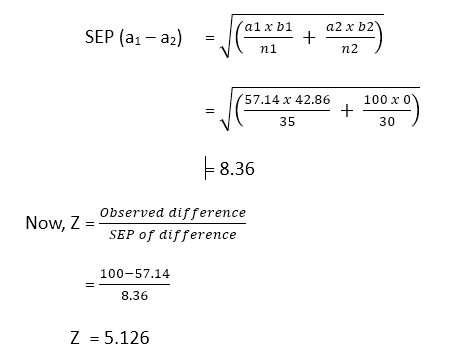
Another way of calculation (Z-test),
Let,
a1 = 20 out of 35 = 20/35 x 100 = 57.14%
∴ b1 = 100 – 57.14 = 42.86%
a2 = 30 out of 30 = 30/30 x 100 = 100%
∴ b2 = 100 – 100 = 0%
n1 = 35 n2 = 30
Formula:
Chi-square statistic: 22.15
p-value: 2.52 × 10⁻⁶
Degrees of freedom (df): 1
This p-value is much smaller than 0.05, indicating a statistically significant difference between the two groups.
Conclusion:
The observed difference in the number of abrupt increases in eruptions between the Sulphur 1M group and the Placebo group is not due to chance. It is likely due to the influence of the Sulphur 1M remedy, supporting the idea of homeopathic aggravation under the Law of Minimum Dose.
Another way of calculation (Z-test),
Let,
a1 = 20 out of 35 = 20/35 x 100 = 57.14%
∴ b1 = 100 – 57.14 = 42.86%
a2 = 30 out of 30 = 30/30 x 100 = 100%
∴ b2 = 100 – 100 = 0%
n1 = 35 n2 = 30
Formula:
The difference is highly significant because at 99% confidence limits Z is more than 3 times SEP. Therefore, abruptly increased eruptions of chicken-pox within 24 hours is due to Sulphur 1M. The factor behind it is illustrated by Hahnemann in §160.
Again in §161 for chronic diseases, he said that such increase of original symptoms of a chronic disease can appear only at the end of treatment when the cure is almost or quite finished.
Application of Laws (Doctrine of Drug Dynamization)
Q1: What did Hahnemann say about the application of drug dynamization?
A: Hahnemann did not define the significance of each potency level in detail. He left this decision to the physician’s experience and intuition. However, he recommended higher potencies in minimum doses to avoid homoeopathic aggravation. In the footnote of §276, he discussed the consequences of low dynamizations. In §270 (footnote) of the 6th edition of Organon of Medicine, he introduced the 50 millesimal potency, claiming it produced medicines with the highest development of power and mildest action. He suggested using lower potencies in acute diseases and increasing potency gradually in chronic diseases.
Q2: What was the clinical study conducted to test the effect of Bryonia alba in different potencies?
Hypotheses:
Null hypothesis (H₀): The effectiveness (relief) is independent of the potency used (i.e., differences occurred by chance).
Alternative hypothesis (H₁): The effectiveness depends on the potency used (i.e., differences are significant).
Chi-square value: 21.67
Degrees of freedom: 2
p-value: 0.00001973
Interpretation:
Since the p-value is much less than 0.05, the result is statistically significant. Therefore, the differences in patient relief were not due to chance, but due to the potency of Bryonia alba.
Conclusion:
This supports Hahnemann’s view that potency selection affects therapeutic outcomes. In this case, Bryonia alba 0/1 was most effective in treating acute viral fever symptoms, showing that lower potencies can be more curative in acute conditions when well-matched to the symptoms.
Clinical Context:
- Hahnemann’s recommendation to adjust potencies based on disease nature (e.g., starting low in chronic cases, repeating low potencies in acute cases) aligns with the observed results.
- The 0/1 potency (LM potency) showed the best result in acute viral fever, which is consistent with the idea that frequent repetition of mild doses is ideal for acute cases.
A: A study was conducted on 60 patients suffering from acute viral fever who presented with the symptoms of:
Dryness of mouth and mucous membranes
Thirst for large quantity of cold water
They were divided into three groups of 20 patients each and given:
- Bryonia alba 0/1
- Bryonia alba 30
- Bryonia alba 200
Relief was observed in 20, 10, and 6 patients respectively in each group.
Dryness of mouth and mucous membranes
Thirst for large quantity of cold water
They were divided into three groups of 20 patients each and given:
- Bryonia alba 0/1
- Bryonia alba 30
- Bryonia alba 200
Relief was observed in 20, 10, and 6 patients respectively in each group.
Hypotheses:
Null hypothesis (H₀): The effectiveness (relief) is independent of the potency used (i.e., differences occurred by chance).
Alternative hypothesis (H₁): The effectiveness depends on the potency used (i.e., differences are significant).
Chi-square value: 21.67
Degrees of freedom: 2
p-value: 0.00001973
Interpretation:
Since the p-value is much less than 0.05, the result is statistically significant. Therefore, the differences in patient relief were not due to chance, but due to the potency of Bryonia alba.
Conclusion:
This supports Hahnemann’s view that potency selection affects therapeutic outcomes. In this case, Bryonia alba 0/1 was most effective in treating acute viral fever symptoms, showing that lower potencies can be more curative in acute conditions when well-matched to the symptoms.
Clinical Context:
- Hahnemann’s recommendation to adjust potencies based on disease nature (e.g., starting low in chronic cases, repeating low potencies in acute cases) aligns with the observed results.
- The 0/1 potency (LM potency) showed the best result in acute viral fever, which is consistent with the idea that frequent repetition of mild doses is ideal for acute cases.
